Through its smart vending machines, the Noida-based company is offering 24/7 convenience to customers, reach to over 200 brands and new business opportunities to entrepreneurs
Workers at Reliance Industries Ltd.’s Jamnagar plant which is in the middle of nowhere never have to worry about getting food, irrespective of the hour. They can get traditional Gujarati savouries like theplas and khakras 24/7 at the touch of a button from any of the 120 machines installed on the premises. These smart machines by Daalchini Technologies were a saving grace for them during the lockdown.
The Noida-based company enables 24/7 autonomous retail through smart stores, phygital kiosks and vending machines at manufacturing plants, ports and offices of Adani, Tata, BMW, Tech Mahindra, Wipro, Mercedes, and many others, alongside over 190 brands like Sleepy Owl, The Whole Truth Foods, and industry giants like Dabur, Nestle HUL, Nestle, Whirlpool and Aditya Birla Group.
In just seven years since its inception, Daalchini boasts 6 lakh monthly active users. The company was even invited to demonstrate its vending machines during the G20 Summit at Pragati Maidan.
The inspiration
Co-founder of Daalchini, Prerna Kalra was introduced to the power and convenience of the machines during one of her work visits to China. She was impressed that they could dispense almost every kind of fresh food item—from fruits to momos. And they were ubiquitous. “While vending machine-based retail was so deeply penetrated in China, I still saw my father owning a mom-and-pop store in a tier 2 city and finding it challenging to expand it to more locations. It just clicked in my mind,” remembered the Noida-based entrepreneur who struggled to find fresh food as a working professional. Vending machines seemed to be the answer to both problems—that of scaling up her father’s retail business and getting food 24×7.
At the time, Prerna headed products at Paytm, which she joined as one of the first few employees. It is there that she met Vidya Bhushan who later became the co-founder when she started her business in August 2017.
Working with organisations like Paytm, Paytm Payments Bank, and FINO Payments, she gathered valuable experience in product management, strategy and business, which helped her as an entrepreneur.
All the elements of her background added up in helping her set up and then scale her business from two machines in Delhi-NCR to 2100 installations across the country today.
The growth
Kalra started by first becoming a distributor of fresh food from home chefs and tiffin services and later scaled through D2C brands helping them launch through its network of phygital distribution points.
Since its inception, the company has grown about 22% to 24% on a quarter-quarter level, barring the Covid period. “We have at least doubled our revenue each year. Just a year before COVID, we did about Rs 5 crore, then last to last year we did about Rs 12 crore, last year we did about Rs 24 crore,” Kalra shared.
The business model
The Indian vending machine space has three kinds of players: Traders who procure the machines and sell them, distributors who operate them on a last-mile level and IT companies that build software around the machines. “We have stitched together these three. The vending machines we provide come with the overall package as well as supply chain partners of brands,” said Kalra explaining that Daalchini gets its vending machines designed and contract manufactured, loads them with its custom-built software and also connects them with over 200 brands.
“Our business model is not making money by selling more devices, but rather by servicing them. That is why our focus has been to get more franchise partners,” said the entrepreneur. Presently, 95% of its machines are operated by franchisee partners (30% of whom are women), who mostly hail from tier 2 and tier 3 cities like Kanpur, Vapi, Kuch, Daman, Shillong, and Guwahati. Out of the 60 cities in which the company is present, it has warehouses in less than 10. “We have distributors in the other 50 cities where the partners manage the entire last mile operations,” she added.
Typically, a franchisee can start with Rs 1.5 lakh investment and a 6X6 ft of space.
Furthermore, Daalchini provides the option to either buy the machines or take them on a subscription model. For partners choosing the first option, the company helps procure funds from its non-banking finance (NBFCs) partners. For instance, one of its franchise partners in Kanpur operates more than 11 vending machines servicing some hospitals and colleges in the area. When she wanted to expand from one machine to many, Daalchini helped her connect with its funding partners.
The ecosystem
While on one hand Daalchini works with franchise partners and brands on the other, it connects with consumers through social media, website and app. Consumers use the channels to find nearby products, and vending machines and share feedback.
The ecosystem helps customers to get what they need when out of home, brands to reach customers minus logistic issues and retailers or entrepreneurs to scale their business and serve customers round the clock without being present.
“More than 60%-70% of our consumers for the vending machines come through online mechanism. We have LinkedIn, Instagram, Facebook where we post videos etcetera on how these vending machines can be useful to consumers and as well as retailers,” explained Kalra.
The brand uses search history and other data and feedback from its app and website to understand what consumers want and then convey the insights to brands who can then tweak their product offerings accordingly.
The machines
Daalchini is an integral part of the evolution that is happening in micro-retail, thanks to the advancement in technology. Today’s machines are smart, adaptable and have a wide range of use cases. They can be temperature controlled and dispense anything from food and beverages, perishables, personal care and hygiene to wellness products to stationery and electronics. They accept payments through UPI, net banking, and wallets and offer automated inventory tracking. They can even predict demand using AI.
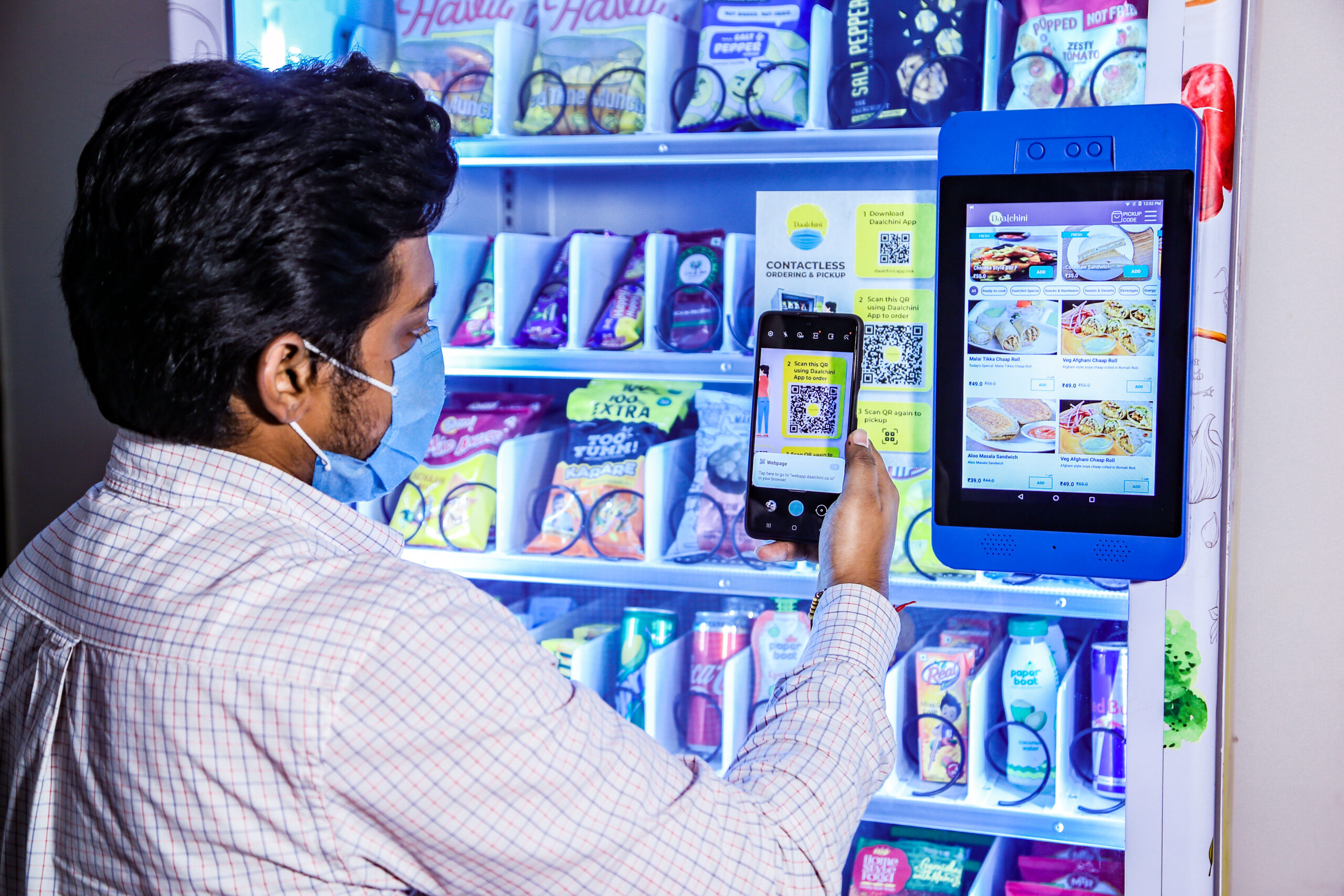
“Replenishment requirements get automatically conveyed to the delivery person on the partner app, who then refills the vending machine. The entire logic is handled within the software,” explained Kalra.
The user experience has evolved too. Users can just search for products they want or locate the nearest device using the Daalchini app or website, buy or reserve their product and collect it from the machine. “This is a different kind of convenience when consumers are out of home. They don’t need to be at a vending machine to find out what’s available. They can do that sitting right where they are. This is a big shift in micro retail that has happened in recent times,” explained Kalra.
As the devices come equipped with cameras, smart locks, and sirens, which go off upon signs of forced entry, they also reduce the chances of shrinkage—a huge risk in unmanned stores.
The ambition
In September 2022, Daalchini raised about $4 million and has been using it to fuel its growth. But now, Kalra and the team want to step up on the expansion and have new horizons in sight.
While Kalra’s ultimate ambition is to be present at every 200 metres of habitable area, her objective in the next two years is to be there in at least 30% of the cities with over 1,00,000 population. “There are 300 such cities so we want to be present in at least 100 of them. These are locations where the consumer would be needing a convenience 24X7 through smart devices,” she said.
The first target in Daalchini’s expansion plan is out-of-home consumption, which includes offices (co-working spaces, factories) and institutions such as colleges, universities and hospitals. “These are the two big segments which we are targeting as we speak,” she said.
The immediate focus is to go deeper into the cities the brand is present in and expand into more verticals like petrol pumps and chemist shops.
Regarding revenue targets, Kalra said, “This year, we would double our last year’s revenue of Rs 24 crore and we should be touching around Rs 100 crore ARR (annual recurring revenue).”
The post How Daalchini is spicing up micro retail in India appeared first on India Retailing.
from India Retailing https://ift.tt/iWNjtkG
via IFTTT
Comments
Post a Comment